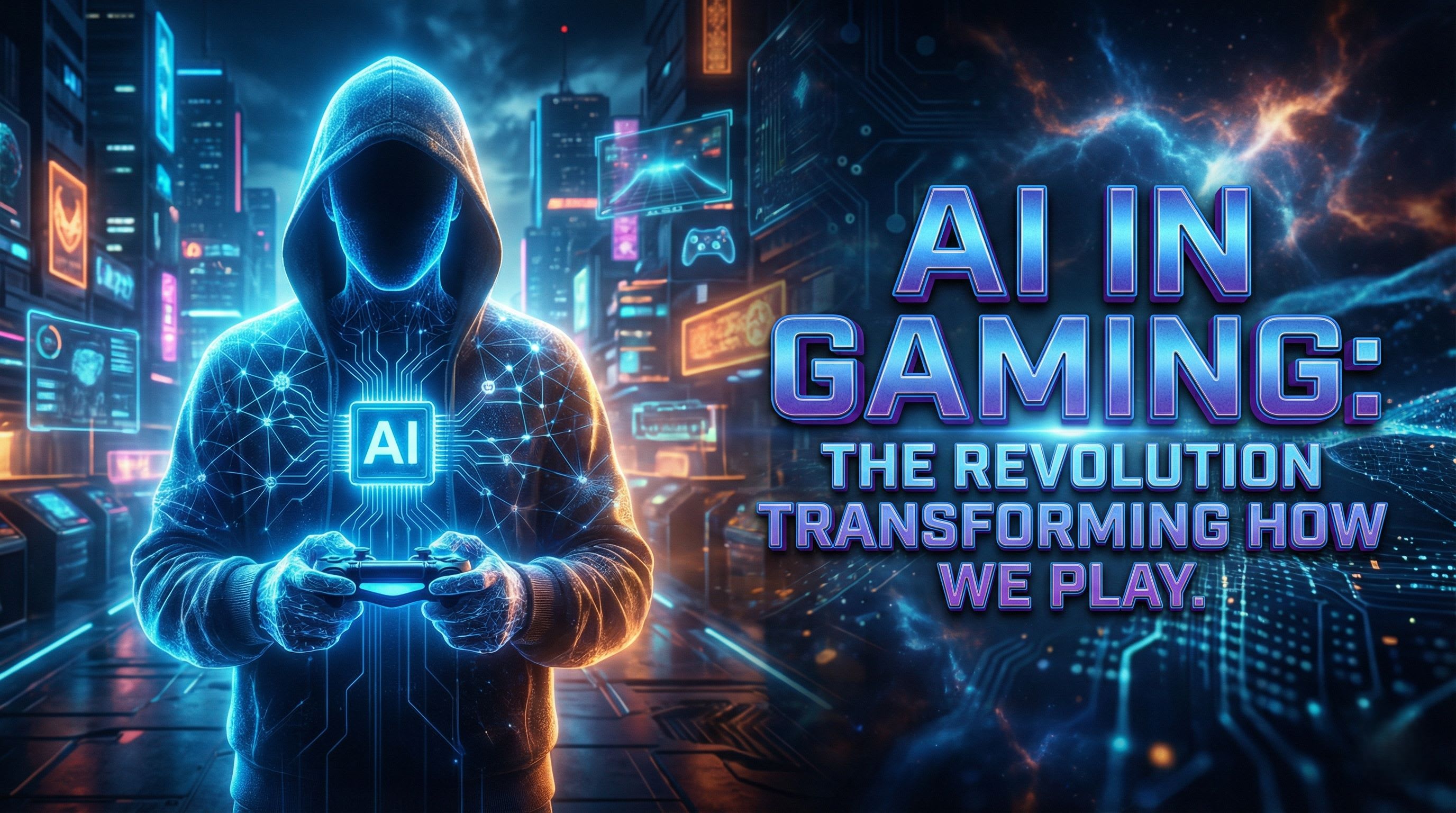
AI in Gaming: The Revolution Transforming How We Play
Artificial Intelligence (AI) isn't just a buzzword confined to science fiction or tech labs; it's a living, breathing force deeply embedded within the fabric of our favorite video games. From the subtle nuances of character behavior to the sprawling, procedurally generated worlds we explore, AI in gaming is quietly (and sometimes overtly) shaping the very essence of interactive entertainment. This isn't your grandfather's tic-tac-toe AI; we're talking about sophisticated systems that adapt, learn, and fundamentally alter how we perceive and interact with digital realms.
The Evolution of AI in Games
For decades, AI in games was relatively rudimentary. Think back to the ghosts of Pac-Man, following predictable patterns, or early arcade enemies moving along pre-programmed paths. These were essentially complex state machines, designed to create a challenge without true intelligence.
Early Beginnings and Scripted Responses
In the 80s and 90s, AI primarily relied on finite-state machines and hard-coded scripts. Characters would react to specific stimuli with predetermined actions. While effective for the technology of the time, this often led to predictable enemy behaviors and limited replayability once players learned the patterns.
The Rise of Behavior Trees and Modern AI
As hardware advanced, so did the complexity of game AI. The early 2000s saw the wider adoption of behavior trees, allowing for more flexible and layered decision-making. Today, modern game AI incorporates elements of machine learning, neural networks, and advanced pathfinding algorithms, enabling characters to exhibit behaviors that are far more convincing, challenging, and often, surprisingly human-like.
Smarter NPCs and Adversaries
Perhaps the most noticeable impact of advanced AI in gaming is the transformation of Non-Player Characters (NPCs). Gone are the days of enemies standing still waiting to be shot or allies mindlessly following a fixed route.
Adaptive Enemies and Companions
Modern AI allows adversaries to exhibit complex tactical behaviors, coordinate attacks, flank players, and even learn from player strategies. Games like F.E.A.R. pioneered this with squad-based AI that genuinely felt like a coordinated unit. More recently, titles like Middle-earth: Shadow of Mordor and Shadow of War utilized the groundbreaking Nemesis System, where AI enemies remember past encounters, gain ranks, and develop unique personalities, making each playthrough feel deeply personal and dynamic. Your actions directly influence their growth and animosity, creating compelling rivalries that wouldn't be possible without sophisticated AI.
Similarly, AI companions are no longer just cannon fodder; they can offer genuine tactical support, heal players, solve puzzles, and even engage in dynamic conversations. This elevates the sense of immersion and companionship, making the player feel less alone in vast game worlds. To understand the depth of these systems, you can dive deeper into game AI development, exploring how industry leaders craft intelligent game entities.
Dynamic Worlds and Procedural Generation
AI isn't just confined to character behavior; it's also a powerful tool for constructing and evolving game environments.
Infinite Universes and Evolving Landscapes
Procedural generation, heavily reliant on AI algorithms, allows developers to create vast, unique worlds that can stretch to infinite possibilities. Games like No Man's Sky generate entire star systems, planets, flora, and fauna on the fly, ensuring that no two players have the exact same exploratory experience. Minecraft, while simpler in its execution, also uses procedural generation to create its boundless blocky landscapes, offering endless discovery.
Beyond initial generation, AI can also manage dynamic events within these worlds. Weather systems, ecological interactions, and even political landscapes in complex simulation games can be influenced and evolved by AI, reacting to player actions and creating a persistent, living world that feels responsive and alive.
Personalization and Adaptive Experiences
One of the most exciting frontiers for AI in gaming is its ability to tailor the experience directly to the player. This moves beyond simple difficulty settings to a more profound level of individual customization.
AI as a Dynamic Game Master
Imagine a game that subtly adjusts its challenges based on your skill level, offers quests perfectly aligned with your playstyle, or even crafts narrative branches that resonate with your in-game choices and preferences. This is the promise of adaptive AI. By analyzing player data—such as combat effectiveness, exploration habits, preferred weapons, or even emotional responses—AI can act as an intelligent game master, dynamically adjusting parameters like:
- Difficulty Scaling: Seamlessly increasing or decreasing challenge without breaking immersion.
- Content Generation: Spawning relevant side quests, loot, or encounters.
- Narrative Adaptation: Shifting story beats or character interactions based on player decisions or sentiment.
This personalized approach ensures that each player receives an optimal, engaging experience, preventing frustration from being too hard or boredom from being too easy. For more insights into how AI is making games uniquely yours, you can read more about AI-driven personalization.
AI-Powered Game Design and Development
AI's influence isn't limited to the player's experience; it's also fundamentally changing how games are made.
Automating Creativity and Streamlining Workflows
Game developers are increasingly leveraging AI tools to assist in various stages of production:
- Asset Creation: AI can generate textures, 3D models, or even sound effects, significantly speeding up the art pipeline.
- Level Design: AI can assist designers by generating initial level layouts or suggesting optimized enemy placements.
- Quality Assurance: AI agents can playtest games tirelessly, identifying bugs, balance issues, and exploits far more efficiently than human testers.
- Animation: AI can assist in procedural animation, creating more natural and responsive character movements.
By automating repetitive or data-intensive tasks, AI frees up human developers to focus on the truly creative aspects of game design, pushing the boundaries of what's possible in interactive storytelling and mechanics.
Challenges and Ethical Considerations
Despite its immense potential, the integration of AI in gaming isn't without its challenges and ethical considerations. Over-reliance on procedural generation can sometimes lead to worlds that feel vast but empty, lacking the handcrafted charm of bespoke design. There's also the